


Cycling Nutrition: How to Fuel Sportives and Training Rides Like a Pro
You can have the legs, the bike and the training plan, and still come undone at kilometre 140 because you stopped eating an hour ago. What you eat before, during and after a ride decides how far you can go, how hard you can push and how quickly you bounce back for the next day.
With this in mind, we’ve taken a deep dive into the best nutrition for cycling further and faster while avoiding the dreaded bonk. Guided by one of SportActive Luxury Cycling’s professional coaches, this article will put you on the right road to success.
Please note: this article is for general information only and isn’t medical advice. Speak to your GP or a registered dietitian before making major changes to your diet.
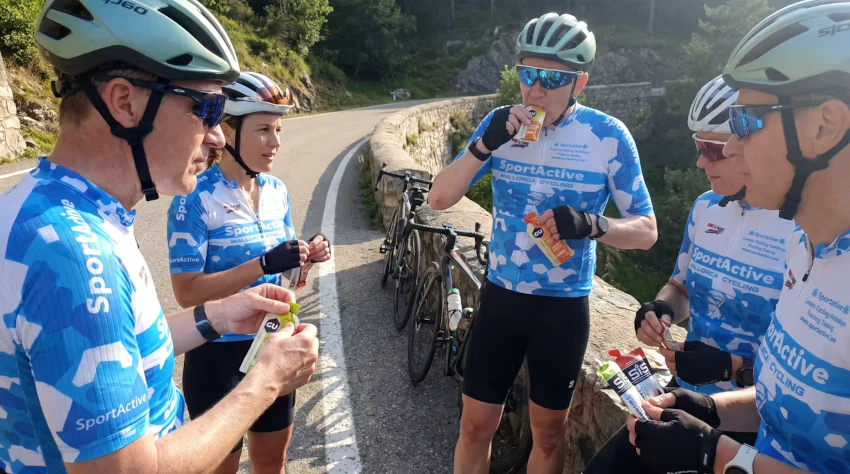 Approach cycling nutrition with a training mindset
Long Endurance Rides and Sportives such as the Marmotte Granfondo Alps and Mallorca M312
If you’re looking at distance rather than intensity, consider the following:
- Pre-ride: Eat a meal you know your body can handle. It is tempting to go for a high carb meal, but if your gut can’t tolerate it you may experience issues during the ride. Keep fat (saturated) and fibre fairly low, as both slow down digestion. Make sure you have at least two water bottles, one with plain water and one with electrolytes if your ride is over two hours.
- During the ride: The pros take up to 120g of carbs an hour in the form of gels and liquid.
Gels aren’t easy to digest, especially the more acidic ones, and it often takes time for your gut to tolerate them. Work towards 60g an hour, taken as two 30g gels, which are easier to consume on rides over two hours. Always mix your gels with water before swallowing so the gel doesn’t block your airway and may cause choking. Where you can, mix in a liquid carb mix, and energy bar.
As you improve, you may find you can handle 90g of carbs an hour. If you take more than 60g an hour, your body needs a mixture of glucose and fructose to absorb the carbohydrate. Check the ingredients of different gel brands to make sure they’re suitable, as gels vary hugely. It is good practice to ensure the gel contains Maltodextrin. This kind of gel absorbs rapidly in the gut without drawing excessive water.
If the gels contain caffeine, ensure that for a 30g gel it contains no more than 80ml caffeine max, and you take no more than 2 gels per 3-hour ride. Too much caffeine can affect your heart rate, causing issues on the bike.
If your ride is between 1–2 hours, take 30g of carbs an hour. When you’re buying a gel, do comprehensive research to determine the gel contains mostly carbohydrates.
Drink around 400–800ml of water an hour, depending on temperature and intensity. For rides over two hours, make sure one of your water bottles contains electrolytes, as the salt you lose in sweat varies hugely from rider to rider.
On all endurance rides, start eating 30–45 minutes in. - After the ride: Consume a high-protein drink. Aim for 1g per kilo of your weight. So if you’re 70kg should have a 70g drink. Never drink more than what you need. The drink will replenish your muscles. Take some carbs afterwards to replenish your glycogen stores.
High Intensity Rides
Not all rides are about distance; some are about intensity. For this kind of cycling, it is recommended:
- Pre-ride: Again, eat a meal that you know you can handle before you hit the road. Keep fat (saturates) and fibre fairly low.
- During: On rides under an hour, take pre-workout energy drink For specific intense work, you’ll need a liquid based carbohydrates for a short intense workout.
If the pace is high, example level 2, on a 1–2 hour ride, aim for 60g an hour. Drink the same amount of water as on long-distance rides and always drink when taking a gel. Drink small amounts/often. Never drink too much at a time to avoid becoming bloated. - After the ride: Follow the same procedure as a long endurance ride.
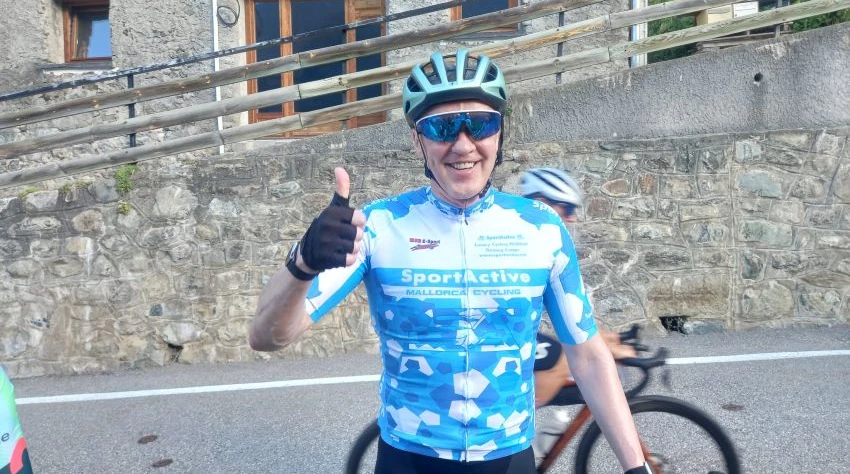 Experiment with your nutrition to find out what works for you
Cycling Nutrition and Training
Training is where you experiment with different gels to train your gut to handle more carbohydrate. In effect, your gut needs training as much as your legs.
As such, if you’re training for a big event such as the Mallorca M312 or the Marmotte Granfondo Alps, start practising your event-day fuelling on long training rides well before the big day.
The more you can handle, the further you can ride.
A key fact: Check the ingredients and choose gels with low acid levels, as they’re easier to digest.
Training rides are where you work out:
- Which gels work for you.
- How many carbs an hour you need and can tolerate.
- The mix of gels and food that suits you.
- Your food timings. Practise them: for example, you may find taking a gel 30 minutes before a climb gives your energy levels a good boost. How quickly a gel kicks in varies from rider to rider.
The combination will be unique to you, and it’s only through practice and experimentation that you’ll discover it. Once you’re comfortable with 60g an hour, you can build up gradually towards 90g.
Top cycling nutrition tips:
- Never try a new gel on event day.
- Keep your gels in a small bag on the handlebars or top tube. You’ll find this easier than fumbling in your jersey pockets.
- Plan ahead. If, for example, you’re riding the full 312km of the Mallorca M312, it will take you roughly ten to eleven hours. If you’re taking 60g of carbs an hour, you’ll need around 600g of carbs.
That’s the equivalent of about 20 x 30g gels. Gels will be your main fuel, but swap some of them for solid food where you can such as energy bars and carb-based drinks. Find out where the feed stations are and make sure you have enough fuel to get you over the finish line. - Try to include real food on long rides. A banana is worth around 25g of carbs, roughly the same as a gel.
- Only eat on a straight road with a clear view ahead and no riders close by, and practise eating without taking your eyes off the road.
Productive nutrition on the bike is a question of working out what combination of gels, energy bars, and drinks work for you.
Preparing for the Mallorca M312
At 312km and taking on the Tramuntana Mountain Range, the Mallorca M312 is Europe’s longest amateur sportive. Most riders taking on the full distance are in the saddle for around 10–11 hours, so your fuelling needs a plan, not guesswork.
- The days before: Eat a little more carbohydrate than usual, such as pasta, rice, bread and potatoes, and keep fibre low the day before. Stick to foods you know. Avoid over eating and avoid processed sauces.
- Breakfast: The M312 rolls out of Playa de Muro at 6:30am, eat a breakfast you know you can handle. (ours is served from 5am).
- Your fuel plan: 10–11 hours at 60g an hour comes to around 600g of carbs. Don’t try to get it all from gels. Count energy bars and carb-based drinks towards your total.
- Eat early: Start fuelling 30–45 minutes in, well before the Tramuntana climbs. The early flat kilometres in the peloton are the easiest time to eat solid food.
- Pack it right: Carry what you need between feed stations in your handlebar or top-tube bag, with spares in your pockets. Check the organiser’s feed station locations before race day.
- Drink: Refill both bottles at every feed station, one with plain water and one with electrolytes. April mornings can be cool, but the afternoon on the climbs can be warm.
- Riding the M225 or M167? The same rules apply. Scale your total to your time in the saddle.
Preparing for the Marmotte Granfondo Alps
The Marmotte covers around 174km and 5,000m of climbing over the Glandon(1,924 m), Télégraphe(1,566 m), Galibier(2,642 m) and Alpe d’Huez(1,850 m). It’s shorter than the M312, but almost all of it is climbing, so most of your fuel goes is for long climbs at a steady effort.
- Breakfast does the early work: The Col du Glandon starts after only about 12km, so your breakfast and an early gel get you over the first col. Eat a breakfast you know you can handle. Don’t go for an unfamiliar breakfast as this may cause issues during the event (ours is served from 5am).
- Your fuel plan: Base it on your expected finish time. A good rule of thumb for a 9-hour ride at 60g an hour needs around 540g of carbs, the equivalent of 18 x 30g gels. Ensure you mix in energy bars and carb-based drinks towards your carb total.
- On the long climbs: On a col of an hour or more, take a 30g gel every 20–30 minutes on the easier ramps, always with water.
- Use the feed stations: In 2026 they were at the top of the Glandon (km 36), in Valloire (km 98), at the top of the Galibier (km 115) and in Bourg d’Oisans (km 162), with water points in between. Check the 2027 details. Eat at the summits, before the long, fast descents.
- Heat and cold: It can be 30°C in the valleys and under 10°C on the Galibier. Drink and take electrolytes in the hot valleys, and pack a gilet for the descents. If you ride with us you can store your gilet and other equipment in one of our support vehicles.
- Watch the cut-offs: In 2026, riders had to reach the top of the Galibier by 15:30 and the foot of Alpe d’Huez by 17:45. Fuelling well from the start is what keeps you inside them.
- Top up before Alpe d’Huez: Take a gel with water on the run-in from Bourg d’Oisans, so the fuel is in your legs for the 21 hairpins. If you’re riding with us, our back-up cars carry spare food and kit to the top of the climbs, and a support car waits at the foot of Alpe d’Huez.
Summing up Energy Gels for Cycling – Which Ones are Best?
There are several brands of energy gels on the market, and the chances are they will be the backbone of your fuelling. Like all things in life, however, they are not created equal. Here’s a guide:
- As stated, 30g gels are preferred to train your gut
- Ensure they contain 30g of carbs and avoid ones that are overly acidic
- Some gels contain caffeine. Ensure you take no more than 2 caffeine gels on a three-hour ride. More than this and you can increase your heart rate which makes you unsteady on two wheels. A gel should have no more than 80ml caffeine
- It is good practice to use gels that contain Maltodextrin. This kind of gel absorbs rapidly in the gut without drawing excessive water and, as such, reduces the risk of sloshing or cramping
- Where you can, always complement gel consumption with energy bars and water with electrolytes and carbs
- Always take gels with water, mixing them before swallowing to avoid choking
Conclusion: Find What Works for You
Sports nutrition science moves fast. Our own 2022 version of this guide suggested 20–40g of carbs an hour. Today’s research points to 60–90g, and some pros now push past 100g.
That pace of change is why so much of the advice out there conflicts. Many studies are done on small groups of elite athletes, not everyday riders. Older advice lingers online long after it’s been overtaken, and plenty of what you read comes from brands selling a product.
We can’t state this strongly enough. Always research carb products thoroughly to ensure you’re getting a real carbohydrate-based gel that contains what it states.
No wonder riders end up confused.
Start with 60g an hour, wash every gel down with water, mix in real food, and use your training rides to find what your gut can handle. Treat the numbers here as a starting point, not a rulebook.
The best place to put it all into practice is a week of big riding days with someone else taking care of the logistics. Join us on a Mallorca cycling holiday, or take on the Mallorca M312 or the Marmotte Granfondo Alps with SportActive, and ask us anything you like about fuelling on the road.
Sources
- Morton, J.P. et al. (2026). From Metabolism to Medals: Contemporary Perspectives and Revisiting Carbohydrate Guidelines for Fueling Endurance Athletes During Exercise. The Journal of Nutrition.
- Thomas, D.T., Erdman, K.A. & Burke, L.M. (2016). Nutrition and Athletic Performance. Joint position statement of the Academy of Nutrition and Dietetics, Dietitians of Canada and the American College of Sports Medicine.
- Martinez, I.G. et al. (2023). The Effect of Gut-Training and Feeding-Challenge on Markers of Gastrointestinal Status in Response to Endurance Exercise: A Systematic Literature Review. Sports Medicine, 53, 1175–1200.
- Zhang, X., O’Kennedy, N. & Morton, J.P. (2015). Extreme variation of nutritional composition and osmolality of commercially available carbohydrate energy gels. International Journal of Sport Nutrition and Exercise Metabolism, 25(5), 504–509.
- Hamilton, A. Drinks vs gels: how to choose for maximum performance. Sports Performance Bulletin.
- Sawka, M.N. et al. (2007). Exercise and fluid replacement. American College of Sports Medicine position stand. Medicine & Science in Sports & Exercise, 39(2), 377–390.
- Williams, J. (2024). Why hydration is more important than you think for cycling performance. road.cc, with Precision Fuel & Hydration.
- Ask Cyclist: When should I take a gel? (2018, updated 2023). Cyclist.
Submitted on: 13/11/2026


